


Das Stadtfest von Sitges macht einen Schritt nach vorne für mehr Barrierefreiheit und Inklusion.
Sitges Town Council and the Municipal Commission for Sant Bartomeu and Santa Tecla continue to move forward in the commitment to develop a more open, accessible and inclusive Festa Major (local town festival).
This year’s festival brings new measures and reinforces existing initiatives with the aim of everybody, regardless of their abilities or needs, being able to take part in and enjoy the Festa Major with maximum guarantees.
The goal is for accessibility to form part of the planning process for the festival in a cross-cutting and progressive way, further developing existing measures and adding new ones based on the experience of this edition.
Pilot project for reserved spaces at parades
One of the main new aspects is the introduction of a pilot project to reserve spaces for wheelchair users, a need previously not catered for during the parades and processions at the local festival. In this first stage, the process is for users of manual or motorised wheelchairs.
The idea is for this experience to allow future editions to evolve and offer spaces for people with reduced mobility, whether they use wheelchairs or not, thus catering for a wider range of people.
During parades and processions, reserved spaces will be set up at the following points:
- Processó Cívica de Sant Bartomeu: Aragó with the alley at Can Pau Xic, and Francesc Gumà with Jesús.
- Processó Cívica de Santa Tecla: Rafael Llopart with Joan Maragall.
- Processions of Sant Bartomeu and Santa Tecla: Francesc Gumà with Jesús and Passeig de la Ribera, next to La Cobla.
Users can attend with up to three other people with a reserved seat, the goal being to prioritise wheelchair users.
A registration form will be available on the website sitgesfestamajor.cat to facilitate organisation, with a question so that each person can indicate if they are in a position to be exposed to fireworks or not when the fire beasts and devils’ groups go past. This information will enable the most suitable spaces to be assigned according to the preferences and needs of each participant.
Besides parades, the Festa Major will also have reserved spaces for wheelchair users at various shows, concerts and activities promoted by the Municipal Commission. The full list of activities, as well as the access conditions and whether advance bookings are required or not, will be in the official Festa Major programme to be presented on 30 July.
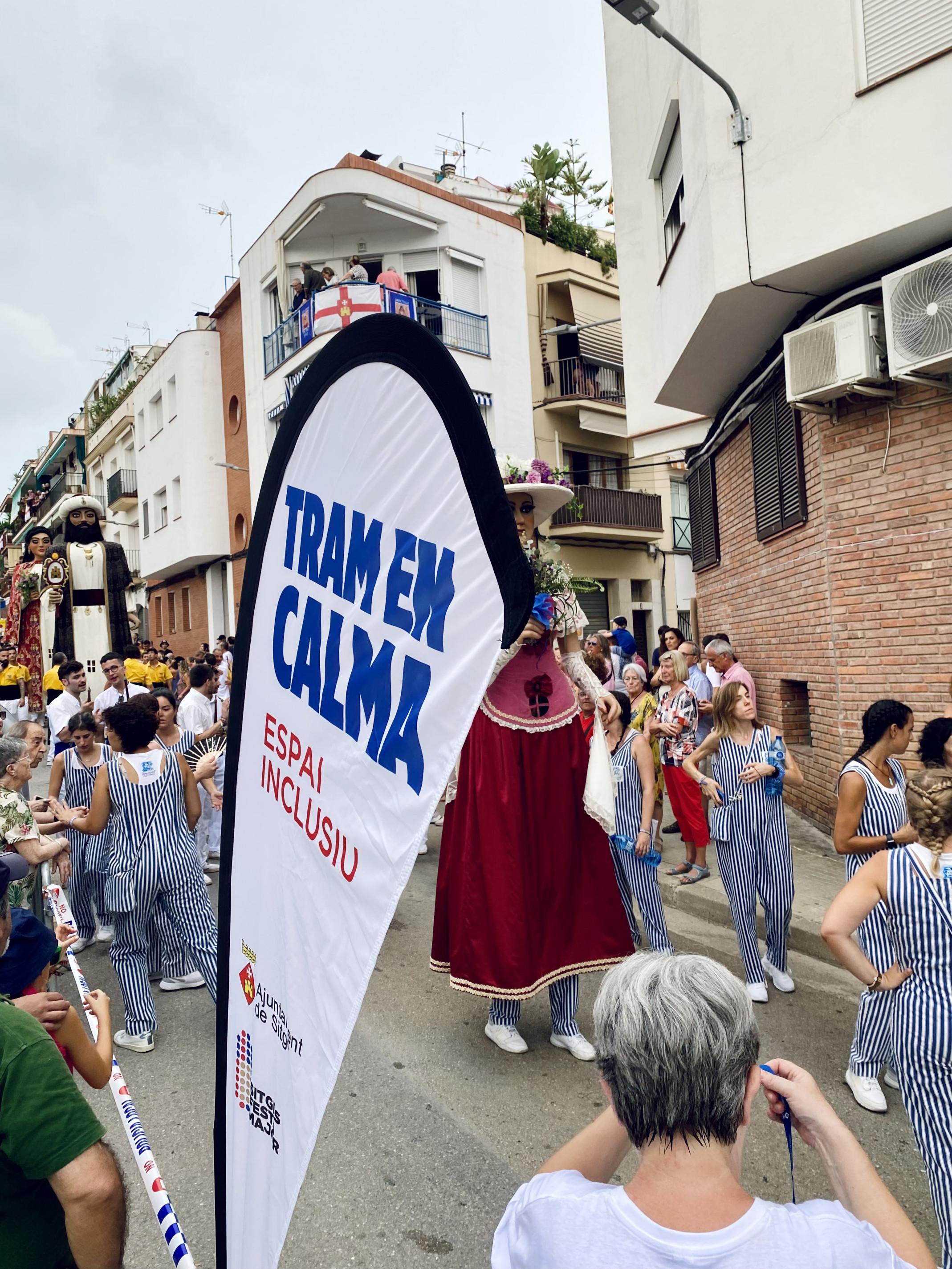
Consolidation of the ‘Tram en calma’
The festival also retains is toned-down section by the name of the ‘Tram en calma’ during the Sant Bartomeu procession on 24 August and the Santa Tecla procession on 23 September. Located in Sant Gaudenci, this initiative is being maintained after the positive reception of recent editions.
The section is specifically designed for people with hypersensory conditions, autism spectrum disorders (ASD) or any other condition that makes it difficult to enjoy an environment with intense stimulation, even though it is open to anybody who needs it.
When the procession goes through this section, the main stimuli typical of festival parades are reduced: the volume of the music is turned down, there are no firecrackers, strobe lights or any other particularly intense elements and measures are implemented to avoid large crowds of people so that onlookers can enjoy the festive entourage calmly.
This space is not silent or isolated from the festival but is instead a one-off adapted area that allows people to experience processions in a more comfortable way for those who need it.
Deaf people can experience the ‘gralla’ festival sounds with vibrating rucksacks
An important first for this edition will be the introduction of vibrating rucksacks during the entrance of the traditional ‘gralla’ pipes and drumming to the Plaça de l’Ajuntament, an initiative that allows deaf people or those with impaired hearing to perceive the music in a more immersive way.
These rucksacks transform the audio and sound into vibrations that are synchronised with the music, making it possible for users to physically experience the rhythm, intensity and different sound frequencies, turning the music into a sensory experience.
The initiative is being applied thanks to the collaboration of Canal Blau TV and the specialist company EnBucle, a leader in aural accessibility solutions, and comes as part of the Municipal Commission’s desire to incorporate new resources that make the Festa Major increasingly inclusive.
More activities with interpretation in Catalan sign language
Another significant first is the addition of more activities with simultaneous interpretation in Catalan sign language (LSC).
Previously this service was available for the opening speech of the festival. This year it will be offered in various activities in La Plaça, as well as different traditional events such as the spoken dances of Sant Bartomeu and Santa Tecla.
The goal is to make it easier for deaf people to take part in many more activities and gradually move towards a more accessible Festa Major for everybody.
The official programme being presented on 30 July will identify all the activities where this service is available, as well as the rest of the accessibility measures planned, so that attendees can plan their participation in advance.
More inclusive funfair
The funfair will again be offering some adapted days for people with sensory diversity to be able to enjoy it in a friendlier atmosphere. Rides will be operating with no music or flashing lights from 6 pm to 8 pm on 12,13,19 and 20 August, reducing sensory stimuli and making it easier for children, teenagers and families to take part in this festive space.
Introduced last year, this initiative complements the rest of the measures applied during the local festival and helps to make one of the spaces most used by children and young people more accessible.
Teilen
Verwandte Themen
Noticies
-
- Mai 2026
-
- Februar 2026
-